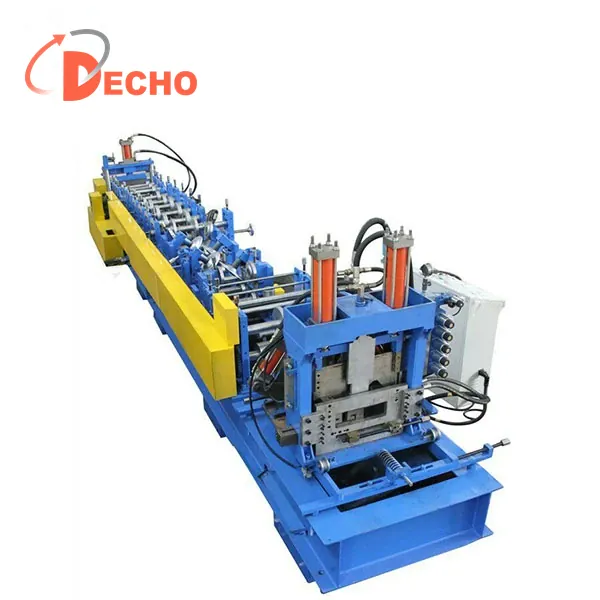
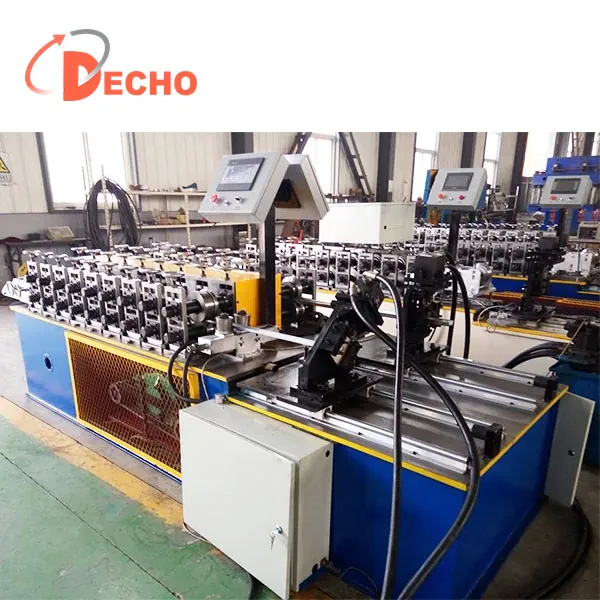
Roll forming machines are essential equipment in the metal processing industry, offering high efficiency and precision in shaping continuous metal strips into various profiles. As a roll forming machine supplier, I have extensive experience with these machines and understand their capabilities and limitations. In this blog, I will delve into the limitations of roll forming machines to provide a comprehensive understanding for potential buyers.
1. Limited Profile Complexity
One of the primary limitations of roll forming machines is their ability to produce complex profiles. Roll forming works by passing a metal strip through a series of rollers, each performing a specific bending or shaping operation. While this method is highly effective for creating simple and repetitive profiles such as straight channels, angles, and tubes, it struggles with more intricate designs.
Complex profiles often require multiple bends, curves, and non - uniform cross - sections. The nature of roll forming, which relies on a sequential and relatively straightforward set of operations, makes it difficult to achieve these complex geometries. For example, profiles with sharp internal corners or irregularly shaped cross - sections may not be feasible to produce on a standard roll forming machine. Even if a complex profile can be formed, it may require a large number of roll stands and a highly customized machine setup, which significantly increases the cost and production time.
2. Material Restrictions
Roll forming machines are designed to work with specific types of materials, and there are limitations regarding the materials they can process. Most roll forming machines are optimized for metals such as steel, aluminum, and copper. These materials have certain properties, such as ductility and malleability, that make them suitable for the roll forming process.
However, materials with low ductility, high hardness, or brittleness pose challenges. For instance, some high - strength steels or certain types of alloys may crack or break during the roll forming process due to the high stresses involved. Additionally, non - metallic materials like plastics and composites are generally not suitable for traditional roll forming, as they do not have the same deformation characteristics as metals.
The thickness of the material also matters. Roll forming machines have a limited range of material thicknesses they can handle. If the material is too thin, it may wrinkle or deform unevenly during the forming process. On the other hand, if the material is too thick, the machine may not have sufficient power to bend it properly, leading to incomplete forming or damage to the rollers.
3. Initial Setup and Tooling Costs
Setting up a roll forming machine for a new profile can be a costly and time - consuming process. Each profile requires a unique set of roll tooling, which is custom - designed and manufactured to shape the metal strip into the desired cross - section. The cost of designing and fabricating these roll tools can be substantial, especially for complex profiles.
In addition to the tooling cost, the initial setup of the machine also involves adjusting the rollers, aligning the guides, and programming the control system. This process requires skilled technicians and can take several hours or even days, depending on the complexity of the profile. As a result, the high initial setup costs make roll forming less economical for small - batch production runs. For companies that need to produce a small quantity of a particular profile, the cost per unit can be prohibitively high due to the amortization of the setup and tooling costs.
4. Limited Length and Width Capabilities
Roll forming machines have limitations in terms of the length and width of the profiles they can produce. The length of the profile is often restricted by the length of the machine's production line and the handling capabilities of the material. Longer profiles may require additional support and handling equipment to prevent sagging or deformation during the forming process.
Regarding the width, the width of the metal strip that can be fed into the machine is limited by the size of the rollers and the overall design of the machine. If a wider profile is required, it may not be possible to use a standard roll forming machine. In some cases, wider profiles can be achieved by welding or joining multiple narrower strips, but this adds an additional step to the production process and may affect the quality and integrity of the final product.
5. Maintenance and Downtime
Roll forming machines are complex pieces of equipment that require regular maintenance to ensure optimal performance. The rollers, which are the key components of the machine, are subject to wear and tear over time. As the rollers wear, the quality of the formed profiles may deteriorate, leading to dimensional inaccuracies and surface defects.
Regular maintenance tasks include lubricating the moving parts, checking the alignment of the rollers, and replacing worn - out components. However, maintenance can be time - consuming and may require the machine to be shut down. Unscheduled breakdowns can also occur, which can cause significant downtime and disrupt production schedules. The cost of maintenance and the impact of downtime on production efficiency are important factors to consider when using roll forming machines.
6. Lack of Flexibility in Production Changes
Once a roll forming machine is set up for a specific profile, it is relatively inflexible when it comes to making production changes. Switching to a different profile requires changing the roll tooling, which is a time - consuming and costly process. This lack of flexibility can be a problem for companies that need to produce a variety of profiles in small quantities or those that need to quickly respond to changes in customer demand.
In a dynamic market environment, where product designs and customer requirements are constantly evolving, the inability to quickly adapt the roll forming machine to new profiles can put a company at a competitive disadvantage. While some modern roll forming machines offer more flexibility through modular tooling and advanced control systems, the overall flexibility is still limited compared to other manufacturing processes such as stamping or machining.
Conclusion
Despite these limitations, roll forming machines remain a valuable and widely used manufacturing solution for producing long, continuous metal profiles. At our company, we understand these limitations and work closely with our customers to find the best solutions for their specific needs. We offer a range of roll forming machines, including the Double Layer Roofing Sheet Roll Forming Machine, Door Frame Roll Forming Machine, and CZ Purlin Roll Forming Machine, which are designed to minimize these limitations and provide high - quality products.
If you are considering purchasing a roll forming machine or have any questions about our products, we encourage you to contact us for a detailed discussion. Our team of experts will be happy to assist you in choosing the right machine for your production requirements and to help you overcome any challenges you may face.
References
- "Metal Forming Handbook: Processes and Applications", edited by G. E. Totten and D. S. MacKenzie.
- "Roll Forming Technology" by J. D. Verhoff.