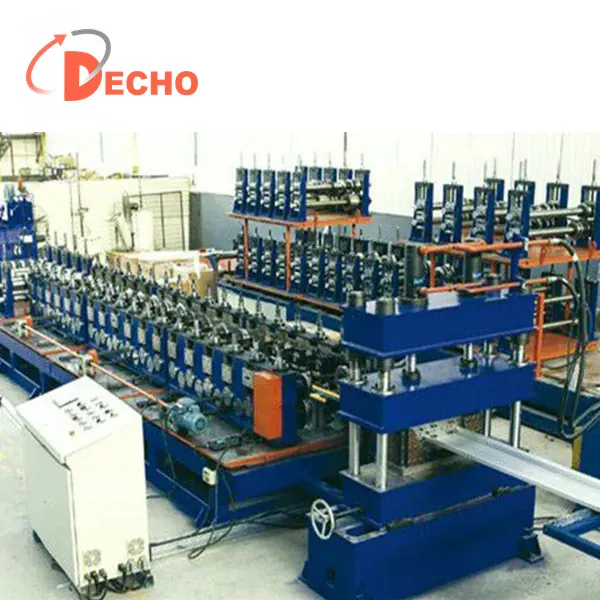
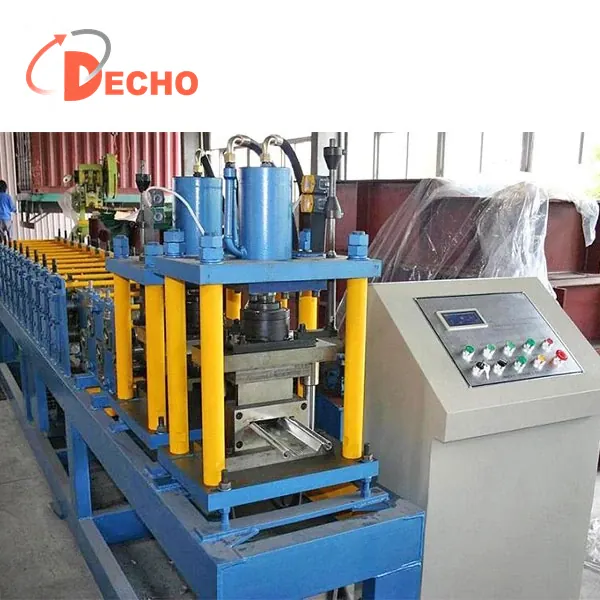
In the realm of metal fabrication, roll forming is a widely adopted manufacturing process that involves passing metal sheets through a series of rollers to gradually shape them into desired profiles. As a leading Metal Roll Former supplier, we've witnessed firsthand the intricate relationship between various process parameters and the quality of the final products. One such crucial parameter is the feed rate, which significantly impacts the quality of roll - formed products.
Understanding Feed Rate in Roll Forming
The feed rate in a metal roll former refers to the speed at which the metal sheet is fed through the roll - forming machine. It is typically measured in linear units per unit of time, such as meters per minute or feet per minute. This rate is determined by several factors, including the design of the roll - forming tooling, the type and thickness of the metal being formed, and the complexity of the profile.
Impact on Dimensional Accuracy
One of the primary effects of feed rate on roll - formed products is its influence on dimensional accuracy. When the feed rate is too high, the metal may not have sufficient time to conform fully to the shape of the rollers. This can result in products with dimensions that deviate from the design specifications. For example, in the production of Rolling Shutter Door Machine, if the feed rate is excessive, the door panels may have inconsistent widths or heights, which can lead to problems during installation and operation.
Conversely, a very low feed rate can also cause issues. Although it allows more time for the metal to form, it can lead to over - forming in some areas. This over - forming can cause the metal to stretch or compress more than intended, again resulting in dimensional inaccuracies. In the case of Metal Stud Roll Forming Machine, low feed rates may cause the studs to have non - uniform thicknesses or cross - sectional shapes, which can compromise their structural integrity.
Surface Finish
The feed rate also has a notable impact on the surface finish of roll - formed products. A high feed rate can generate more friction between the metal sheet and the rollers. This increased friction can cause scratches, abrasions, or even galling on the surface of the product. For instance, in the production of Roller Shutter Door Machine, a high - speed feed can leave visible marks on the door surface, which not only affects the aesthetic appearance but also may reduce the corrosion resistance of the product.
On the other hand, a low feed rate generally results in a better surface finish. With slower movement, the metal has a more gentle interaction with the rollers, reducing the likelihood of surface damage. However, extremely low feed rates can lead to longer production times and increased energy consumption, which are not economically viable in large - scale manufacturing.
Material Properties
The feed rate can alter the material properties of the roll - formed products. High feed rates can induce residual stresses in the metal. These stresses occur because the rapid deformation during high - speed forming does not allow the metal to relax and redistribute its internal forces properly. Residual stresses can lead to problems such as warping, cracking, or reduced fatigue life of the product.
In contrast, a moderate feed rate helps to minimize the development of residual stresses. The metal has enough time to deform gradually, allowing the internal forces to be more evenly distributed. This results in products with better mechanical properties and a longer service life.
Production Efficiency
From a production perspective, the feed rate is directly related to the overall efficiency of the roll - forming process. A higher feed rate generally means more products can be produced in a given time. However, as mentioned earlier, high feed rates can lead to quality issues. Therefore, finding the optimal feed rate is a balance between quality and production speed.
In our experience as a Metal Roll Former supplier, we've found that by carefully adjusting the feed rate based on the specific requirements of each project, we can achieve a high level of both quality and efficiency. For example, for simple profiles with less demanding quality requirements, a relatively high feed rate can be used to increase production volume. For complex profiles or products with strict quality standards, a lower feed rate may be necessary to ensure the desired quality.
Finding the Optimal Feed Rate
Determining the optimal feed rate for a roll - forming process is not a one - size - fits - all approach. It requires a comprehensive understanding of the metal material, the profile design, and the capabilities of the roll - forming machine.
Firstly, the type of metal being formed plays a crucial role. Different metals have different mechanical properties, such as ductility, hardness, and yield strength. For example, aluminum is more ductile than steel, which means it can be formed at a relatively higher feed rate without significant issues. Steel, on the other hand, may require a lower feed rate, especially if it is a high - strength alloy.
Secondly, the complexity of the profile affects the feed rate. Profiles with sharp bends, deep embossments, or multiple curves require a slower feed rate to ensure proper forming. In contrast, simple straight - sided profiles can tolerate higher feed rates.
Finally, the capabilities of the roll - forming machine itself need to be considered. Modern roll - forming machines are often equipped with advanced control systems that allow for precise adjustment of the feed rate. These systems can also monitor various process parameters in real - time and make automatic adjustments to optimize the feed rate.
Conclusion
In conclusion, the feed rate has a profound effect on the quality of roll - formed products in a metal roll former. It impacts dimensional accuracy, surface finish, material properties, and production efficiency. As a Metal Roll Former supplier, we understand the importance of finding the optimal feed rate for each project. By carefully considering the type of metal, the profile design, and the machine capabilities, we can ensure that our customers receive high - quality roll - formed products.
If you are in the market for roll - formed products or are interested in learning more about our Rolling Shutter Door Machine, Metal Stud Roll Forming Machine, or Roller Shutter Door Machine, we invite you to contact us for a detailed discussion. Our team of experts is ready to assist you in selecting the right solutions for your specific needs and to ensure a smooth and successful procurement process.
References
- Smith, J. (2018). "Advanced Roll Forming Techniques". Metal Fabrication Journal.
- Johnson, A. (2019). "The Impact of Process Parameters on Roll - Formed Product Quality". Manufacturing Research Review.
- Brown, C. (2020). "Optimizing Feed Rates in Metal Roll Forming". Industrial Engineering Magazine.