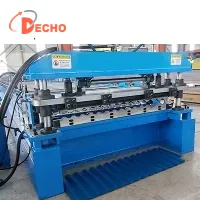
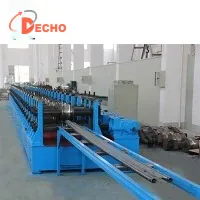
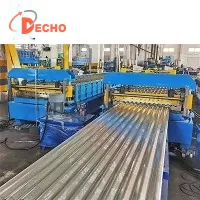
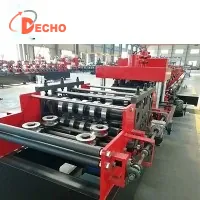
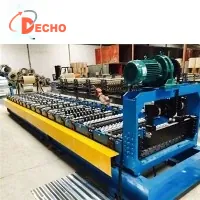
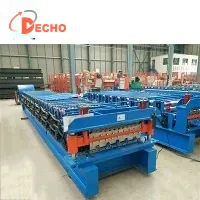
Downspout roll forming machine is a kind of equipment specially used for manufacturing downpipes. Downpipes are pipes used to discharge rainwater from roofs, usually installed under the eaves of buildings. Downpipe forming machine produces downpipes by processing metal sheets or plastic materials into round or other shaped pipes. This equipment is very common in the construction and engineering industries, because downpipes play a very important role in the drainage system of buildings.
The operation of downspout making machine mainly includes the following steps:
1. Loading
Place the raw materials (such as metal sheets, plastic coils, etc.) on the loading device of the downpipe forming machine. The loading device usually adopts an unwinder or unwinding rack, which can smoothly unwind the rolled raw materials and transport them to the subsequent processing links.
2. Leveling
The raw materials after unwinding may be uneven and need to be leveled by a leveling device. The leveling device is generally composed of multiple rollers arranged up and down. Through the extrusion and stretching action of the rollers, the bending, wave and other deformations of the raw materials are eliminated, so that the surface flatness meets the requirements of subsequent processing.
3. Punching (optional)
If the downpipe needs to be punched, such as for installation, fixing or drainage, the leveled raw material will enter the punching stage. The punching device punches the raw material according to the preset hole type and position. The punching die can be replaced according to different hole type requirements to meet the punching needs of various downpipes.
4. Forming
The raw material after leveling or punching (if there is such a step) enters the forming area. The forming area is usually composed of one or more groups of rollers, which are designed and arranged according to the shape and size of the downpipe. The raw material gradually forms the shape of the downpipe under the extrusion and bending of the rollers. During the forming process, it is necessary to control the pressure, speed and other parameters of the rollers to ensure the forming quality and dimensional accuracy of the downpipe.
5. Cutting to size
When the formed downpipe reaches the set length, the cutting device will cut it off. The cutting device can be hydraulically cut, mechanically cut, etc. The cutting accuracy and speed need to match the overall production efficiency of the forming machine. For some downpipe forming machines that require continuous production, online cutting may be used, that is, cutting during the continuous transportation of the downpipe to improve production efficiency.
6. Discharging
The cut downpipe is output from the forming machine through the discharging device. The discharging device must ensure that the downpipe can leave the forming machine smoothly and steadily, and will not cause damage to the formed product.
7. Control system
The entire working process of the downpipe forming machine is monitored and adjusted by the control system. The control system usually uses PLC (programmable logic controller) or industrial computer, which can realize the functions of automatic control, parameter setting, fault diagnosis and other functions of the equipment. The operator can easily adjust the operating parameters of the equipment and monitor the operating status of the equipment through the human-machine interface of the control system to ensure the stable operation of the equipment and the quality of the product.
https://www.jr-rollformingmachine.com/