As a trusted supplier of steel roll forming machines, I'm excited to delve into the intricate working principle of the cutting system in these remarkable pieces of equipment. Steel roll forming machines are widely used in various industries for manufacturing a diverse range of products, including purlins, angles, and roller shutters. The cutting system plays a crucial role in ensuring the precise and efficient production of these components.
1. Overview of Steel Roll Forming Machines
Before we dive into the cutting system, let's briefly understand the basic concept of steel roll forming machines. These machines are designed to transform flat metal sheets into desired cross - sectional shapes through a series of consecutive rolling operations. The process starts with feeding a flat metal coil into the machine. As the sheet passes through a series of rollers, it gradually takes on the desired shape.
The final step in the production process is cutting the formed profile to the required length. This is where the cutting system comes into play. The cutting system must be highly accurate to ensure that each piece meets the specified dimensions and quality standards.
2. Types of Cutting Systems in Steel Roll Forming Machines
There are mainly two types of cutting systems commonly used in steel roll forming machines: mechanical cutting and hydraulic cutting.
Mechanical Cutting
Mechanical cutting systems typically use a mechanical shear mechanism. This mechanism consists of a fixed blade and a moving blade. When the formed profile reaches the cutting position, the moving blade is driven by a mechanical drive system, such as a crankshaft or a cam mechanism, to move towards the fixed blade. The two blades then shear the profile, separating it from the continuous strip.
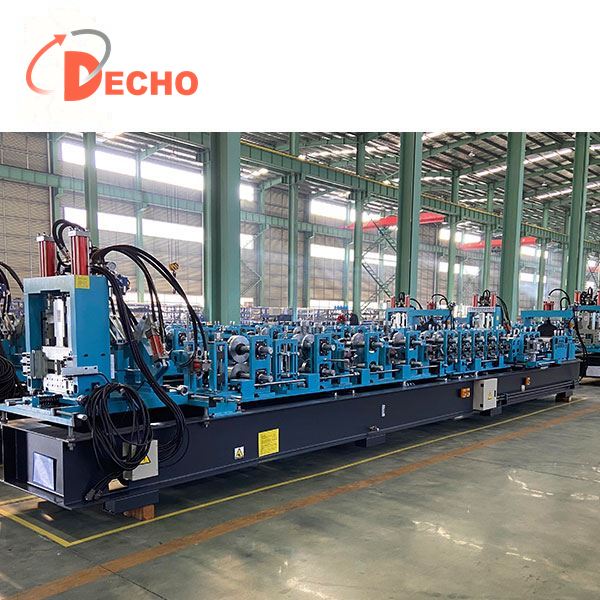
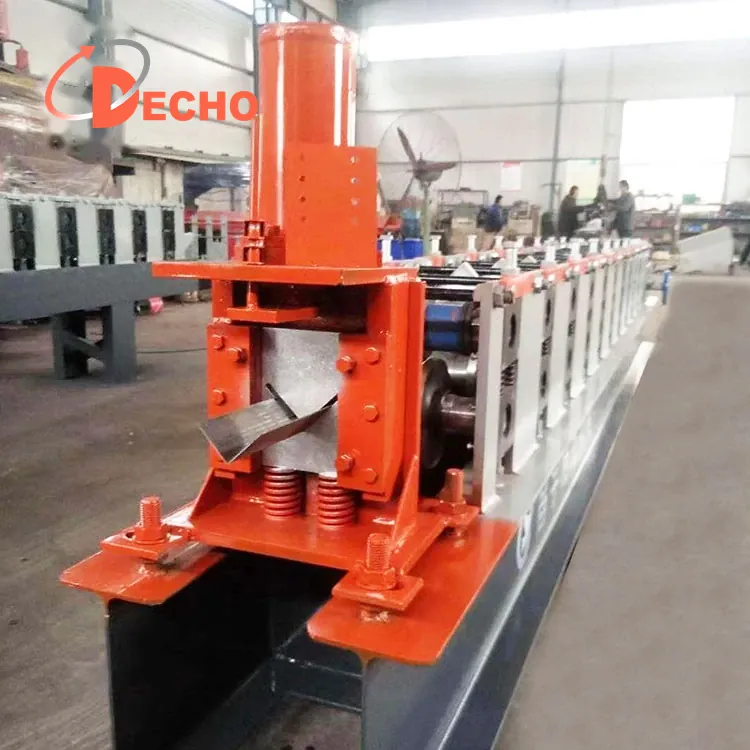
One of the advantages of mechanical cutting is its simplicity and relatively low cost. It is suitable for cutting thinner gauge materials and is often used in smaller - scale roll forming operations. However, mechanical cutting may produce more noise and vibration compared to hydraulic cutting, and the cutting speed is usually limited.
Hydraulic Cutting
Hydraulic cutting systems, on the other hand, use hydraulic power to drive the cutting blade. A hydraulic cylinder is used to move the blade with high force and precision. The hydraulic system can be precisely controlled, allowing for accurate cutting of different thicknesses and materials.
Hydraulic cutting offers several benefits. It can generate a large cutting force, which makes it suitable for cutting thicker gauge steel profiles. The cutting process is relatively quiet and produces less vibration, resulting in a cleaner cut and less wear on the machine components. Additionally, hydraulic cutting systems can be easily integrated with the control system of the roll forming machine, enabling automatic and continuous operation.
3. Working Process of the Cutting System
The working process of the cutting system in a steel roll forming machine can be divided into several key steps:
Detection of the Cutting Position
The first step is to accurately detect the position of the formed profile where the cutting should take place. This is usually achieved through the use of sensors. There are different types of sensors that can be used, such as photoelectric sensors or proximity sensors. These sensors are installed at specific positions along the conveyor path of the formed profile. When the leading edge of the profile reaches the sensor, it sends a signal to the control system of the machine.
Control System Activation
Once the cutting position is detected, the control system of the roll forming machine is activated. The control system, which can be a programmable logic controller (PLC), processes the signal from the sensor and calculates the appropriate time to initiate the cutting operation. It takes into account factors such as the speed of the profile movement, the thickness of the material, and the type of cutting system being used.
Cutting Operation
Based on the instructions from the control system, the cutting mechanism is activated. In the case of a mechanical cutting system, the mechanical drive system starts to move the moving blade towards the fixed blade. For a hydraulic cutting system, the hydraulic pump is activated to supply pressure to the hydraulic cylinder, which then drives the cutting blade.
During the cutting process, the blades must be properly aligned to ensure a clean and straight cut. The cutting force should also be carefully controlled to avoid over - cutting or under - cutting the profile.
Post - cutting Handling
After the cutting operation is completed, the cut piece is usually removed from the cutting area. This can be done manually or through an automated conveyor system. The remaining strip of the formed profile continues to move forward for further processing or cutting of the next piece.
4. Importance of Precision in the Cutting System
Precision is of utmost importance in the cutting system of a steel roll forming machine. A precise cutting system ensures that the final products have the correct length and dimensions. This is crucial for the proper assembly and functionality of the components in various applications.
For example, in the production of Purlin Making Machine, the purlins need to be cut to the exact length to fit the structural requirements of a building. Any deviation in the cutting length can lead to installation problems and compromise the integrity of the structure.
Similarly, when manufacturing Angle Forming Machine products, precise cutting is necessary to ensure that the angles have the correct shape and size for use in frames, supports, and other applications.
In the case of Roller Shutter Forming Machine production, accurate cutting is essential for the smooth operation of the roller shutters. Incorrectly cut slats can cause jamming or uneven movement of the shutter.
5. Maintenance and Troubleshooting of the Cutting System
To ensure the reliable operation of the cutting system, regular maintenance is required. This includes cleaning the cutting blades to remove any debris or residue, lubricating the moving parts, and checking the alignment of the blades.
Over time, the cutting blades may wear out and need to be replaced. It is important to use high - quality blades that are suitable for the specific material and thickness being cut.
Common troubleshooting issues in the cutting system include uneven cuts, excessive noise, and slow cutting speed. These issues can be caused by various factors, such as blade misalignment, hydraulic system problems, or mechanical drive failures. By following the manufacturer's maintenance guidelines and conducting regular inspections, many of these problems can be detected and resolved in a timely manner.
6. Conclusion and Call to Action
In conclusion, the cutting system in a steel roll forming machine is a critical component that directly affects the quality and efficiency of the production process. Understanding its working principle, types, and importance of precision is essential for anyone involved in the steel roll forming industry.
Whether you are in the market for a Purlin Making Machine, an Angle Forming Machine, or a Roller Shutter Forming Machine, our company is committed to providing high - quality steel roll forming machines with advanced cutting systems.
If you are interested in learning more about our products or discussing your specific requirements, please feel free to contact us. We look forward to the opportunity to work with you and help you achieve your production goals.
References
- Smith, J. (2018). Steel Roll Forming Technology. Publisher: Metalworking Press.
- Johnson, R. (2020). Advanced Cutting Systems in Manufacturing. Journal of Manufacturing Science, 15(2), 123 - 135.