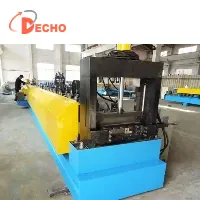
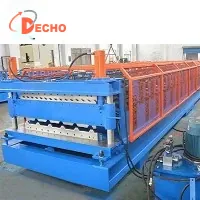
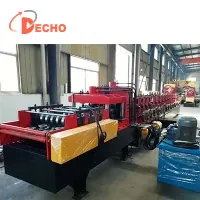
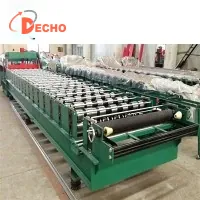
Double layer roll former is a kind of equipment used to process metal sheets. It bends metal sheets into the desired shape through the pressure and movement of double-layer rollers. This machine is usually used to manufacture metal pipes, grooves, profiles, etc. Double-layer roll forming machines are widely used in the metal processing industry to help produce metal products of various shapes and sizes.
The working process of double-layer roll forming machine is generally as follows:
1. Equipment preparation
Power-on inspection: Before turning on the power of the equipment, the operator needs to check whether the various components of the double-layer roll forming machine are in normal condition, including whether the connection of the roller is tight, whether the transmission parts are well lubricated, and whether the electrical control system is normal. For example, check whether there is wear or scratches on the surface of the roller. If there is severe wear, it may affect the forming effect; check whether the lubricating oil level in the reducer is within the normal range. Too low a level will cause the wear of the transmission parts to increase.
Parameter setting: According to the product specifications and process requirements to be produced, set the relevant parameters in the control system, such as the speed, pressure, temperature (if there is a heating function), etc. of the roller. For example, to produce a steel plate product with a thickness of 2mm, it may be necessary to set the roller pressure within a certain range to ensure that the steel plate can be smoothly roll-formed.
2. Loading
Raw material preparation: Prepare the raw materials to be processed and ensure that their quality and size meet the production requirements. The raw materials can be metal sheets, plastic sheets, rubber, etc. For example, for metal sheets, check whether there are impurities such as oil and rust on the surface, and pre-treat them if necessary.
Feeding operation: Place the raw materials on the feeding device, and use the feeding device to convey the raw materials between the rollers of the double-layer roll forming machine. The feeding method can be manual feeding or automatic feeding. The automatic feeding device is usually composed of a motor, a conveyor belt or a screw feeder. During the feeding process, pay attention to controlling the feeding speed and position to ensure that the raw materials can accurately enter between the rollers.
3. Roll forming
Preliminary rolling: After the raw materials enter the upper roller, the upper roller performs preliminary extrusion and pre-forming on the raw materials. In this process, the raw materials will undergo a certain degree of plastic deformation to initially form the shape of the product.
Lower roller pressing: The raw materials after preliminary rolling continue to enter the lower roller, which further rolls and accurately shapes them to make the shape and size of the product more in line with the requirements. The rolling process of the upper and lower rollers is continuous. By controlling the speed, pressure and other parameters of the rollers, the precise control of the product forming process can be achieved.
4. Cutting to length (optional)
Dimension measurement: For products that need to be cut to length, the length of the product will be measured in real time by the measuring device during or after the roller forming process. The measuring device can be a photoelectric sensor, encoder, etc. When the product reaches the set length, the measuring device will send a signal.
Cutting operation: After receiving the signal from the measuring device, the cutting device will start and cut the formed product according to the set length. The types of cutting devices include hydraulic cutting, mechanical cutting, etc. The cutting accuracy and efficiency depend on the performance and parameter settings of the cutting device.
5. Finished product output and inspection
Finished product output: The cut finished product will be output to the finished product collection area through the conveying device. The conveying device can be a conveyor belt, chain conveyor, etc., and its function is to quickly and smoothly convey the finished product to the designated location for subsequent packaging, storage or transportation operations.
Quality inspection: Perform quality inspection on the output finished product to check whether the shape, size, surface quality, etc. of the product meet the requirements. The inspection method can be manual inspection or automated inspection. Automated inspection usually uses visual inspection systems, laser inspection systems, etc., which can quickly and accurately detect product quality problems.
https://www.jr-rollformingmachine.com/