Cold roll forming is a crucial manufacturing process widely used in various industries, and as a cold roll forming supplier, I have witnessed firsthand how this process can significantly affect the mechanical properties of materials. In this blog, I will delve into the details of how cold roll forming impacts the mechanical properties of materials, exploring the changes in strength, ductility, and other key characteristics.
1. Introduction to Cold Roll Forming
Cold roll forming is a continuous bending operation in which a long strip of metal, typically coiled steel, is passed through consecutive sets of rolls to gradually shape it into the desired cross - sectional profile. This process is carried out at room temperature, which differentiates it from hot roll forming. The main advantage of cold roll forming is its ability to produce complex shapes with high precision and consistency at a relatively low cost.
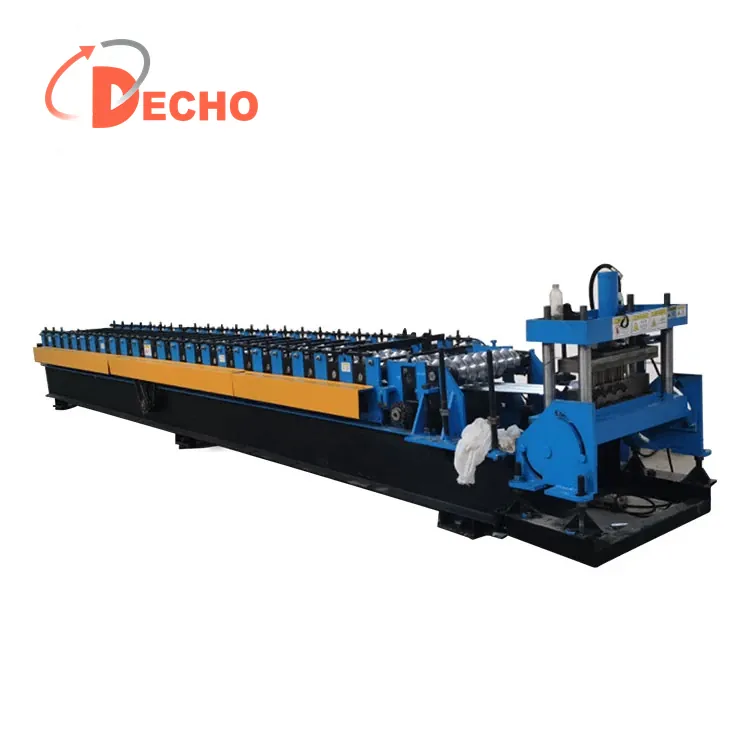
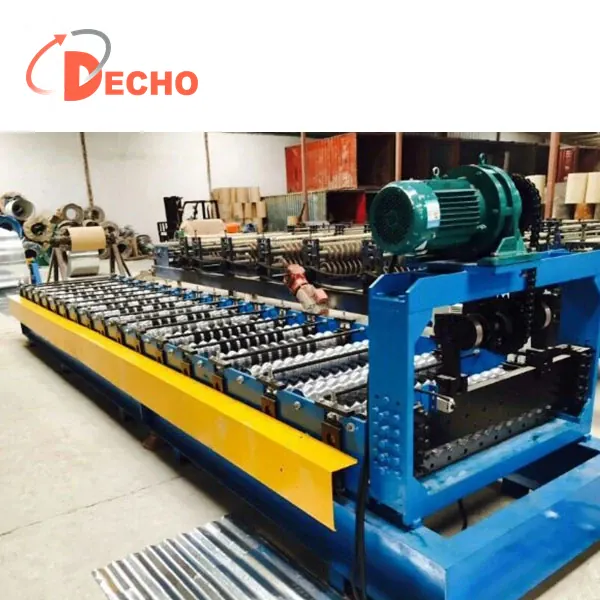
As a cold roll forming supplier, we offer a wide range of machines, such as the Barrel Corrugation Machine, Standing Seam Roll Former, and Roof Panel Roll Forming Machine. These machines are designed to handle different materials and produce various profiles for diverse applications, including construction, automotive, and furniture industries.
2. Effects on Material Strength
One of the most significant impacts of cold roll forming on material properties is the increase in strength. During the cold roll forming process, the material undergoes plastic deformation as it passes through the rolls. This plastic deformation causes the grains within the material to elongate and align in the direction of deformation, a phenomenon known as grain orientation.
The grain orientation leads to an increase in the material's yield strength and ultimate tensile strength. The yield strength is the stress at which the material begins to deform plastically, while the ultimate tensile strength is the maximum stress the material can withstand before failure. The increase in strength is due to the work - hardening effect. Work - hardening occurs when dislocations within the material's crystal structure interact and become entangled during plastic deformation. As more dislocations are generated and entangled, it becomes more difficult for the material to deform further, resulting in an increase in strength.
For example, in the case of steel sheets used in the construction industry, cold roll forming can increase the yield strength by up to 30 - 50%. This increase in strength allows for the use of thinner materials while still maintaining the required structural integrity. As a cold roll forming supplier, we can provide customers with formed products that have enhanced strength, which can lead to cost savings in terms of material usage.
3. Changes in Ductility
While cold roll forming generally increases the strength of the material, it often comes at the expense of ductility. Ductility is the ability of a material to deform plastically before failure. During cold roll forming, the work - hardening effect that increases strength also reduces the material's ability to deform further.
As the material is repeatedly deformed by the rolls, the dislocations within the crystal structure become more and more entangled. This restricts the movement of atoms within the material, making it more brittle and less ductile. For instance, a steel sheet that was initially highly ductile may become more prone to cracking or fracturing after cold roll forming, especially if it is subjected to further deformation or impact loading.
However, the reduction in ductility can be managed through proper process design. By carefully controlling the number of roll stands, the amount of deformation per pass, and the speed of the forming process, we can minimize the negative impact on ductility. Additionally, post - forming heat treatment processes, such as annealing, can be used to restore some of the lost ductility. As a cold roll forming supplier, we have the expertise to optimize the forming process to balance the requirements of strength and ductility for our customers' specific applications.
4. Residual Stress Formation
Cold roll forming also leads to the formation of residual stresses within the material. Residual stresses are internal stresses that remain in the material after the forming process is completed. These stresses are a result of the non - uniform plastic deformation that occurs during cold roll forming.
When the material passes through the rolls, different regions of the cross - section may experience different amounts of deformation. This non - uniform deformation causes some parts of the material to be stretched while others are compressed. As the material tries to return to its original shape but is constrained by the surrounding material, residual stresses are generated.
Residual stresses can have both positive and negative effects on the mechanical properties of the material. On the one hand, compressive residual stresses on the surface of the formed part can improve its fatigue resistance by reducing the likelihood of crack initiation. On the other hand, tensile residual stresses can be detrimental, as they can lead to premature failure, especially under cyclic loading conditions.
As a cold roll forming supplier, we are aware of the importance of managing residual stresses. We use advanced techniques, such as stress - relieving heat treatment and proper roll design, to minimize the magnitude of residual stresses and ensure that they are distributed in a beneficial way.
5. Impact on Anisotropy
Cold roll forming can induce anisotropy in the material. Anisotropy refers to the variation of material properties in different directions. Due to the grain orientation and non - uniform deformation during cold roll forming, the mechanical properties of the formed material can be different in the longitudinal (parallel to the direction of forming) and transverse (perpendicular to the direction of forming) directions.
In the longitudinal direction, the material usually has higher strength and lower ductility compared to the transverse direction. This is because the grains are elongated and aligned in the longitudinal direction, which provides better resistance to deformation in that direction. However, in the transverse direction, the material may be more ductile but have lower strength.
For applications where isotropic material properties are required, such as in some automotive components, this anisotropy can be a challenge. As a cold roll forming supplier, we can work with customers to understand their specific requirements and develop processes to minimize anisotropy or to design components that can effectively utilize the anisotropic properties of the formed material.
6. Fatigue Resistance
The fatigue resistance of a material is its ability to withstand cyclic loading without failure. Cold roll forming can have a significant impact on the fatigue resistance of the formed material. The increase in strength due to work - hardening can improve the fatigue limit of the material, which is the maximum stress amplitude that the material can withstand for an infinite number of cycles.
However, the presence of residual stresses and the reduction in ductility can also have a negative impact on fatigue resistance. Tensile residual stresses can act as stress raisers, promoting crack initiation under cyclic loading. And the reduced ductility means that the material is less able to accommodate the cyclic deformation without cracking.
To improve the fatigue resistance of cold - formed parts, we, as a cold roll forming supplier, can use techniques such as shot peening to introduce compressive residual stresses on the surface of the formed part. Shot peening involves bombarding the surface of the part with small spherical particles, which creates compressive residual stresses and can significantly improve the fatigue life of the component.
7. Corrosion Resistance
The cold roll forming process can also affect the corrosion resistance of the material. During cold roll forming, the surface of the material may be scratched or damaged, which can expose the underlying metal to the environment and reduce its corrosion resistance. Additionally, the residual stresses within the material can create micro - cracks or stress concentrations, which can act as initiation sites for corrosion.
However, as a cold roll forming supplier, we can take steps to protect the formed parts from corrosion. We can apply protective coatings, such as galvanizing or painting, to the formed parts. These coatings act as a barrier between the metal and the environment, preventing corrosion. We can also use corrosion - resistant materials, such as stainless steel, in the cold roll forming process to ensure long - term durability.
8. Conclusion and Call to Action
In conclusion, cold roll forming has a profound impact on the mechanical properties of materials. It can increase strength, but often at the expense of ductility. It also leads to the formation of residual stresses, anisotropy, and can affect fatigue and corrosion resistance. As a cold roll forming supplier, we have the knowledge and experience to optimize the cold roll forming process to meet the specific requirements of our customers.
Whether you are in the construction, automotive, or any other industry that requires high - quality formed parts, we can provide you with products that have the right balance of strength, ductility, and other mechanical properties. Our Barrel Corrugation Machine, Standing Seam Roll Former, and Roof Panel Roll Forming Machine are designed to produce precise and reliable formed parts.
If you are interested in learning more about our cold roll forming services or would like to discuss your specific project requirements, please feel free to contact us. We are ready to work with you to develop the best solutions for your business.
References
- Dieter, G. E. (1986). Mechanical Metallurgy. McGraw - Hill.
- Kalpakjian, S., & Schmid, S. R. (2008). Manufacturing Engineering and Technology. Pearson Prentice Hall.
- ASM Handbook, Volume 14A: Metalworking: Bulk Forming. ASM International.