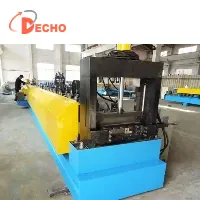
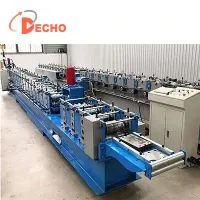
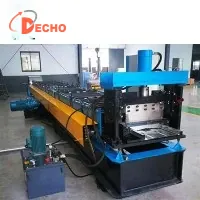
1. Feeding Stage
Upper layer feeding: The raw materials are placed on the upper layer feeding device of the double-layer roll forming machine, that is, the second feeding table. Then, the material enters the first group of second rolling units on the upper layer from the second feeding table.
Lower layer feeding: At the same time, another part of the raw materials are placed on the first feeding table on the lower layer, and then enter the first group of first rolling units.
2. Rolling Stage
Upper layer rolling: On the upper layer, the second rolling unit composed of the second upper roller and the second lower roller rolls the incoming material. There is a channel for the sheet to pass between the second upper roller and the second lower roller. The material undergoes preliminary deformation and forming in the channel through the rotation and extrusion of the two rollers.
Lower layer rolling: On the lower layer, the first rolling unit composed of the first upper roller and the first lower roller rolls the material of the lower layer in the same way. The two adjacent first lower pressing rollers and the two adjacent second lower pressing rollers are connected by the first connecting member and the second connecting member, respectively, so that the coordinated work of multiple first rolling units and the second rolling units can be ensured, so that the material can maintain stable transmission and uniform force during the entire rolling process.
Two-layer coordinated work: The second rolling unit of the upper layer is located between the two first rolling units, and the bottom of the second lower pressing roller is higher than the channel of the first rolling unit. Such a structural design makes the rolling processes of the upper and lower layers independent of each other but coordinated with each other. The materials of the upper and lower layers are formed and processed simultaneously in their respective rolling units without interfering with each other.
3. Drive and Transmission
Drive device: The drive device is usually a power device such as a motor, which is arranged on the frame. It provides power for the rotation of the first rolling unit and the second rolling unit. For example, two driving gears are arranged on the rotating shaft of the cycloid motor, and the first lower pressing roller and the second lower pressing roller are provided with a first driven gear and a second driven gear at the positions corresponding to the two driving gears. The two driving gears are connected to the first driven gear and the second driven gear through a chain, respectively, so as to drive the first lower pressing roller and the second lower pressing roller to rotate.
Transmission process: After the first lower pressing roller and the second lower pressing roller rotate, the power is transmitted to other first lower pressing rollers through the first connecting member (such as the first chain), and the power is transmitted to other second lower pressing rollers through the second connecting member (such as the second chain), so that all the first roller pressing units and the second roller pressing units can operate synchronously to ensure the continuous roller forming of the material.
4. Forming and Discharging
After multiple rolling of the double-layer roller pressing unit, the material gradually forms the required shape and size. Finally, the upper and lower layers of the formed materials are output from their respective discharging ends respectively, completing the entire double-layer roller forming process.
During the entire working process, the forming effect and production efficiency of the double-layer roller forming machine can be controlled by adjusting the gap between the rollers, the pressure, and the speed of the drive device.
https://www.jr-rollformingmachine.com/